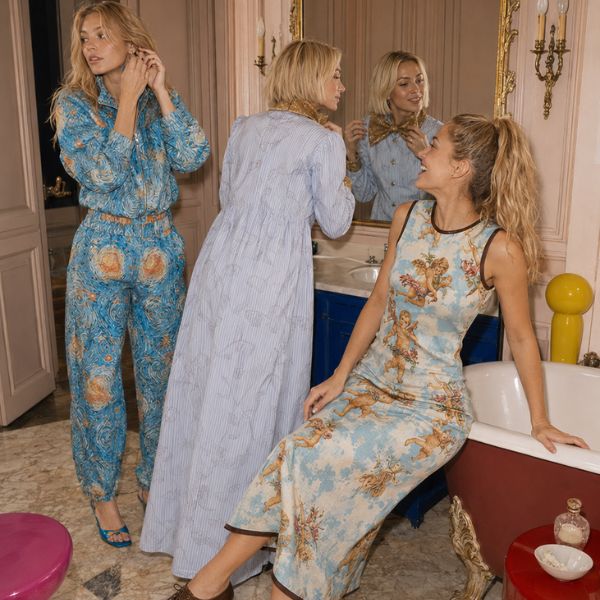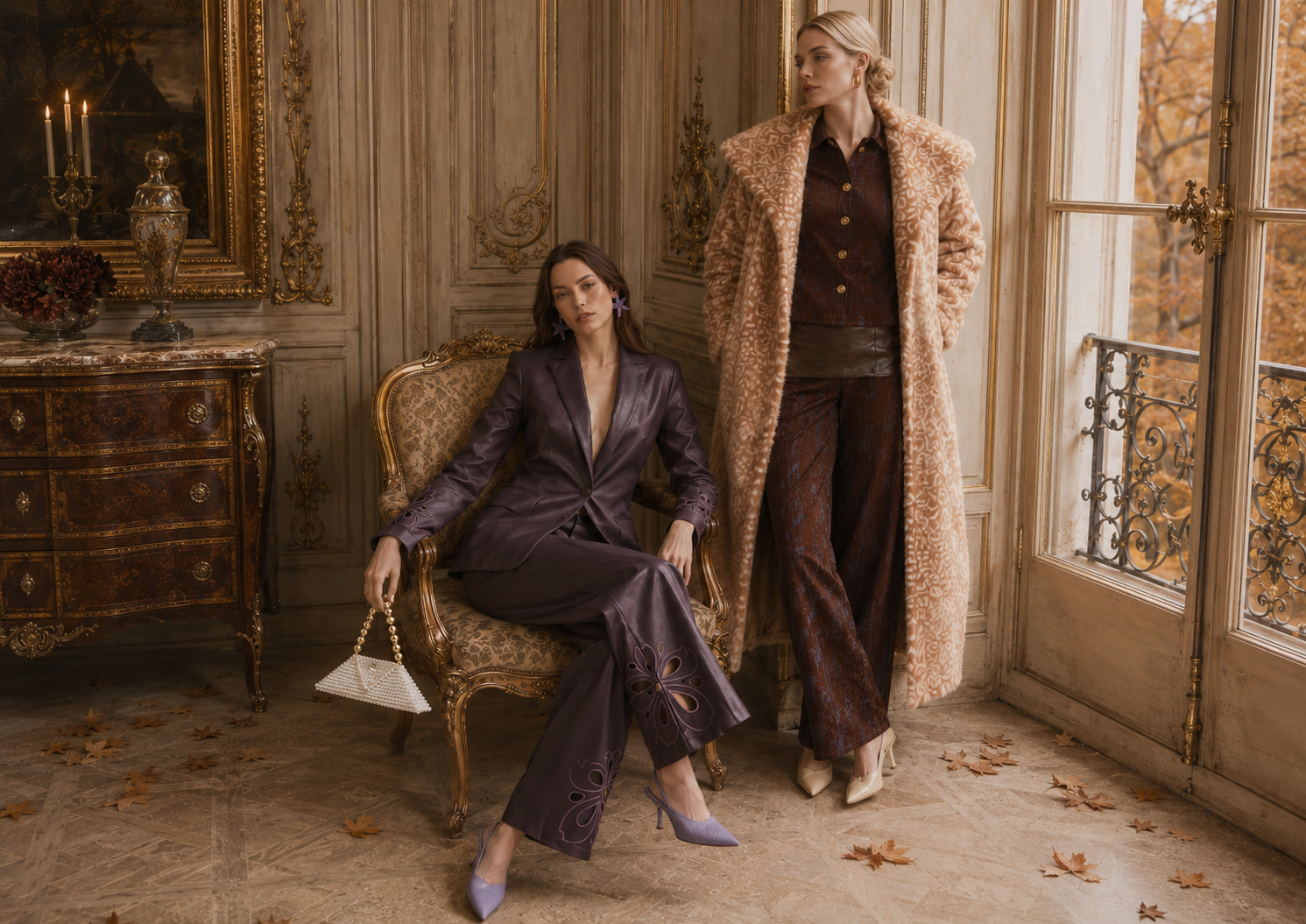

What can a boutique tell a customer about the person behind a garment? In this conversation, designer Nidhi Patel and co-founder Miguel Hebrero discuss how Be Sunset moved from jewellery to apparel, how ideas become samples, and why buyer and wearer feedback changes the next collection.
Watch the full episode on YouTube. The notes below are for buyers and shop teams; the full caption transcript follows at the end.
Three useful takeaways for a buying team
- Sell the design point of view. Nidhi describes a customer who likes expressive details and is comfortable being seen. Choose the pieces that speak to your own customers, then give the team one sentence about the detail worth noticing.
- Test an idea with people outside your circle. The founders recall starting with a small jewellery experiment before committing to larger inventory. For a boutique, the equivalent is observing actual try-ons, questions and purchases before doubling a new shape.
- Record fit feedback precisely. Nidhi talks about revising garments after hearing what buyers and wearers say. A useful agent note names the style, size, part of the garment and desired change; “the fit was wrong” does not give the design team enough to work with.
How to brief a salesperson in five minutes
Pick one garment and identify its most distinctive feature: texture, print placement, silhouette or construction. Show how it pairs with a calmer piece. Tell the team who has responded to it in your store so far, without assuming every customer wants the same look. When a customer tries it, ask what they like and what feels different; note the answer if it affects buying or fit decisions.
Questions to use after watching
- Which three pieces best express the collection in our store?
- Which detail can we explain honestly in one sentence?
- What fit or styling question do customers ask repeatedly?
- What should we send back to our agent before the next buy?
Explore wholesale access if you would like to see the collection or speak to an agent.
Read the full episode transcript
Full episode transcript
Caption transcript; line breaks have been combined for readability.
00:00 — Opening highlights
We had an office affair. That's right, I quit. I quit. I'm resigning. I'm retiring. But put them in front of the strangers and see if they'll actually get their wallet out and pay.
00:14 — Meet Nidhi and Miguel
Hello and welcome to the Be Sunset podcast. Today we have a very, very special guest. It's the one and only Nidhi Patel, designer of Be Sunset, who's going to tell us the designer mindset. And we're going to have a very rare look into what it takes to have a fashion brand to be a designer in 2026. Nidhi, welcome. Hello, Miguel. Hi, I'm Nidhi. I'm so excited to make you go through the journey of my design process and how my mind works. So Nidhi, just for those of you who don't know, Nidhi is my girlfriend and I'm Nidhi's boyfriend.
We've been together for 10 years and one of the most common questions people ask us at dinner parties or friends' getaways is about our job, about our business. Fashion is this thing that everybody wants to be part of and we are trying to give some insights and to welcome all of you, all of our audience into our beautiful world.
01:13 — Quick-fire: dressing to stand out
Now, Nidhi, some quick fire questions. Of course. Bring it on. Whose wardrobe would you steal if you could? That's a tough one. I'm putting you on the spot. Oh, yes, you are. I think that would be Miranda Priestly from Devil Wears Prada. Her wardrobe is amazing. Be Sunset is for a woman who completes the sentence, who is not afraid to stand out. I mean, it's all about the textures, the details, looking out of the place. And that's what it's about. It's definition of who I am as a person. Yeah, that's all right.
And I actually see lots of that in our customers. We spend time in our shop in Sotogrande occasionally and you see our customers, they have so much self-confidence and they know what they like. And you can really tell. So, for example, it's funny that when you get younger clients like 14, 15 years old, they're like, mom, let's go, right? Because for them, it's just a brand they don't know. Their friends haven't approved it. They don't know if it's nice or not. Whereas their moms have lived their whole lives.
And by their moms, I mean these women who are 30, 35 years old, professionals, probably executives who really, really know what they like. And they're like, I like this and I don't care what anybody else is going to say. Exactly. And they love fashion, which is all it's about. Super, super brave women who are not afraid to be seen, you know, that's what it makes it so special. That's right.
02:53 — Where the design journey began
Maybe you've told me the story of how you first got introduced to fashion. Why don't you tell everybody? Well, I would say that I was not even a teenager. I was like a young girl who was obsessed with dolls. And my passion was like every day how I make it look a different outfit that I dress up my doll to. So sometimes I would even make from the scratch a complete new outfit so that she's like dressed up. And that was my passion, like from that age. From from which age, you would say? I would say I was around like eight years old.
Eight years old. Yeah. Yeah. So you were eight years old. Where were you at the time? I was in Gujarat and the fashion was in India. It is in India. And fashion was not such a big thing at that moment. You can imagine like for me looking at watching Hannah Montana was like the biggest thing. I was so attracted to the fashion of like shows at the moment. And I was like, oh, I'm the Hannah Montana girl. And I would make my Barbie like completely dress up like that. That's amazing.
So you got introduced to fashion by Hannah Montana and Western TV from India. That's amazing. Indian fashion is so different than the Western fashion. And at the moment fashion was like still introducing at least to the Indian culture. Indian fashion is completely different than the Western fashion. Now it's cooperative, like, you know, collaborating very well together. Cool. That's cool.
04:31 — From Bombay Sunset to Be Sunset
So people know Be Sunset. They at least know the Be Sunset of today. But Be Sunset hasn't always been what it is today. So what was the very first version of Be Sunset? What did it look like? Very first version of Be Sunset was accessories, jewelry. So given that I'm coming from Indian culture background, we are really heavily into accessorizing ourselves. And that is a big part of our culture, which I do it for myself. I wear heavily accessories. And that's what I brought into the Be Sunset.
I was like, how do we make this fashion without investing so much on inventory of apparel? And that's what was Be Sunset before. That's right. Because a lot of people don't know that Be Sunset started with jewelry. Yeah. And actually Be Sunset was initially called Bombay Sunset. Yes. And I think that's a super nice story because we named it Bombay Sunset because the brand was initially our story of love. And we met in Bombay, right? I was there for work, you were also there for work, we met. And for us... We had an office affair.
That's right, that's right. So Bombay Sunset was a story of love and it meant a lot for us. But we found people saw Bombay in the name. They completely misunderstood. And they just thought we are Indian goods seller. You know, they just thought we go to India, we buy products and we sell them in Europe, which is a complete understatement of all the creative work that goes behind the scenes. Yeah. So we decided to change the name to Be Sunset. At about the same time, we transitioned to apparel and we still do jewelry.
But it's a smaller part of our business because apparel is really what lets Nidhi's creativity shine through.
06:28 — Starting small and validating the idea
So tell me about those first days of Be Sunset. What did we first spend money on? I think more than we spent money on was the idea like Miguel was starting his MBA in IE and we were like brainstorming and I was like, I really want to do this. And he was like super excited to start his new chapter after his MBA. And we did our first experiment in IE in the cafeteria of the college. And I was blown away with the response we got. We didn't do big inventory or anything.
We just really wanted to see how clients respond to the, you know, the craftsmanship of the jewelry. They were all very special jewelry. And we were like it was our first big gig because of course everybody bought it and we were just so happy with like, wow, That's right. So we were at IE Business School in Madrid and we wanted to validate our product market fit.
So we thought okay we're not going to spend months and lots of money in developing designing our own 80 pieces collection where we don't know if people are gonna like it because one of the principles I was uh taught at IE is that fail fast and cheap like whether it's gonna work or it's not work but just know it fast and get done with it. So we thought, let's find products that look similar to what we want to do. Not the same. Let's just put them in front of people and let's see if they're actually going to like it.
And how you know if somebody really likes something is not if your friend or your mom tells you this is nice because they love you or they're always going to say that. But put them in front of the strangers and see if they'll actually get their wallet out and pay. And I remember the feeling we got the taxi. We had lots of, you know, display things, props, boxes and whatnot. I was really, really nervous that day because, you know, all of my classmates were going to see me doing this at the cafeteria.
I remember we didn't ask for permission from the school just in case they said no. So let us say sorry, don't say no. And we sold a lot. It was crazy. I mean, we sold a lot. We sold like eight hundred euros in one day with a table of random jewelry set up at the school cafeteria. I'll say it was a success. We thought there is a market for this. It completely was. I was really surprised to see that. And I was like, yeah, boost me with confidence to do even more and better. That's right.
09:09 — Creative influences and wearable art
So what fashion brand do you really admire right now? Who do you think is bringing something onto the table, doing something good? I would say right now I have few on my top list. One is Farm Rio. I love the colors and the creativity that bring into the fashion world right now, because that's completely my style as well. Then the second is Zimmermann. Oh, my God, the craftsmanship and the details they put into it. I'm like, I always get goosebumps when I see that collection. And the third is Cult Gaia.
I love the structure, the play with the silhouettes and the textures they bring into it. It is something that I admire and I always take it as an inspiration for our Be Sunset as well. They're doing a wonderful job, these brands. Yes, they are. I'd also like to know because I mean, one thing is admiring them, but obviously you have your own creative take on things, right? So how do you make sure your designs stay true to yourself?
I think it's very personal because every brand and designer, they come up with designs and details, which is very personal to them. Everyone has their own unique taste and creativity, which is why each brand is very individually different from one another. And that's why I would get inspired from them because I really love what they do with fashion. And for me, I love that fashion is like art. When you wear it, it's like you are wearing art. And that's where it makes me unique and different from the other brands.
10:49 — Tapestry, jacquard and texture
That's right. So what material, you mentioned material, what material are you obsessed with at the moment? Oh, tapestry and Jacquard. I'm wearing one of the pieces from our autumn winter collection and I just love the textures of it. It just feels so beautiful and like the details. I'm more into the details like I love the playfulness of the textures and the details to it because details are like this whimsical feel like you wear it and you feel like, oh, amazing.
And like who doesn't like to look like beautiful and pretty when they wear something? That's the whole concept of dressing up. That's right. So
11:27 — AW27: nature as the moodboard
how do you describe this process of like from an idea to actually a product to selling at the store? Like talk us through the process. This is like every time I have a different day of process. But like now I'm figuring out like a universal way of doing it. So usually begins with an idea like this. The next collection that I'm working on, which is like autumn, winter, twenty seven. And my idea is like zoom basically like looking into the creativity of the nature, like getting inspired from the colors and like art and then like zoom in.
So all the details like teeny tiny veins of a plant and the colors of the moth and like the wing of a butterfly. That's where it's coming from. So every season I have a different idea and all of them are always inspired from nature. I'm a big nature sucker.
12:25 — The difficult part of creating
I imagine this is a very difficult process, right? Because obviously you start from nothing and you have so many expectations from our customers, agents, everybody. So I mean, it must be honestly like somewhat a lonely process because you start from zero. You don't know if what you're doing is going to be liked by people. And I think at the beginning it must even be difficult to understand yourself whether or not you like it. So and then I guess maybe you have this aha moment where you are like, wow, I love this when it starts taking shape.
Right. But the conceptualization phase of it, I reckon, is quite difficult. And I see it in your eyes. You spend some days going back and forth, picking this fabric, picking that detail, leaving it, taking it again. And it's funny when we have listened to other designers, they all go through the same phase of checking and going back and forth until you're like, wow, I like this. This is really good. And when you first show your designs to me, everything is really new.
Everything is unlike anything we've done and like anything I've seen anywhere else. Right. Because we don't copy other brands, which is really rare in our industry. So for me, when I see them sometimes I'm like, I love this. Sometimes I don't love it so much. And it grows on me. Right. So then I see it the next day and the next day and it grows on me and I end up loving it. And I think those are the pieces which end up doing better, the most unconventional, the most unique designs. So how do you know when you've made it?
Like, how do you know, like, wow, this is a banger? I don't know until I really see clients really loving it. But the process is really difficult. Like I'm usually crying in my tears and always giving up and always saying it to Miguel. Listen, this is my last design process. I don't want to do this again. I quit. I quit. I'm resigning. I'm retiring. I use all the words that is possible. Every six months we go through this process at Be Sunset. Oh, I just had one episode yesterday and I was all like, oh, I don't know what to do about this.
But then when I start thinking about how I want to make it, how I want to use the different textures and like the silhouettes I want to use, how would I want to dress up as a, you know, the younger version of me would want to dress up the doll every day thinking about what a unique way to dress her up. I think about that. I'm like, I want to create a collection. I want to make it feel unique to me. And how would I want to wear it? So I do like every time it's like a year before.
So it really gives me a lot of scary moments of like, oh, what if they love it? What if they hate it? What is going to happen? And it's a very lonely process. And most of the time I'm just having a lot of self-negative talks. But then I take a pause and I just like literally use a pencil, use crayons. I always carry myself with watercolors, notebook, pencil colors so that I can just always like, you know, go in that journey of creating and not overthink it. And that's when I get out of it. Yeah.
Every time I think about it, I just like get me jitters. But then I think about the moments when I've made it through. So it makes me, you know, like, girl, you've done it. Just, you know, believe in yourself and you can do it again. So yeah, I'm like here and there talks all the time.
16:08 — Sampling, waste and feedback
Amazing. So how many versions of our garment, how many sampling versions does a garment go through until it's ready? Now I'm trying to make it in a way where I don't have to go through multiple designing process, especially in like sampling, because I feel like it's a lot of waste and I don't want to do waste. Usually, my mind works in a really crazy way when I know exactly how a piece is going to look like.
And I'm like, sketch it out, put the details, put the elements, and then I'm like, exactly how it's going to look like, and somehow I do make it happen. So I love that feeling like, you know, I'm not going through back and forth in order to, you know, a lot of wastage and a lot of process and like time. Like it's not only my time. It's also my, you know, team who's like manufacturing and all and their time. So I love the idea that I can manage to do that with this effort. And I love the idea like my mind knows how to make it happen.
I do get feedbacks here and there about the fittings and all, which I always love listening to. And I love the room for improvement. That's right. So, like, I mean, it's a little hard because you make a garment that maybe 99% of the people love, but there's gonna be a 1% of people who are not gonna love it because Be Sunset is not for everybody. They're going to give you feedback. And I think as a designer must be hard to listen to negative feedback about your creation, which after all is your baby. But you're a professional.
You go back to the sketch, you work on it again, you improve the fitting. And every year we are improving based on the feedback that we receive from the market. So we really value that. Thank you. Everybody who gives feedback is very important. Like in the end of the day, you are my clients. You're going to wear it. If you're not going to be happy with it, then what am I doing? I'm not doing the right job. I'm not in the right place. Trust me, yes, I hate, like, first, it's like, when I get any criticism, I have to be like, oh shit, yet again.
And like, I feel like, oh, I don't know how to do this. I don't know how I'm going to get through this. It's so difficult. But then I'm like, oh, you're getting a feedback. You can do better. Learn how to do better. And that's what I'm like learning now how to take criticism well, and then like also improve along the way. In the end of the day, this is the journey. And I want to do better every time I do it. And we see growth season after season. And I think there is no better feedback than that.
Like customers coming back, increasing their orders, wanting to experiment more with Be Sunset.
18:51 — Earning the trust of buyers
And let me ask you, because right now we are a little bit known, a little bit better known in some places of Europe, Southern Europe, some states of the US. So buyers do come to us because they see us on the internet and at the shows. But what was it like trying to convince the first wholesale client to buy from you when nobody knew us? My God, that was a difficult one. But I think what made them slowly coming back to us again and again is like doing new creations season after season. Like nowadays, fashion has become slightly boring.
I must say people are just doing the same thing again and again.
For me, the journey is about giving them something new every time they come to the Be Sunset or every time every season they come to Be Sunset and that's the challenge in its own for me but I actually love that challenge because that way I get to give them so many creative versions of Be Sunset and then they can wear from previous season to the current season every time in their wardrobe staple and that's what I like doing I do pair my SS26 garments with my AW and now I'm like SS27 which some snippets you guys have seen.
I'm so excited for that season to launch because it's one of my favorite at the moment. And like, you know, it gives me so many happy vibes. But that's what like I want to do better and better. And I think that's why our clients are coming again and again to us. And I really, really appreciate that. You know, first, they did believe in us. And another thing really important why they're coming to us again and again is the price point. We are very competitive when it comes to our prices with the really good quality. Great.
I think it's all about the creativity. People keep coming to us. And I think Be Sunset provides them that bang for their window, right? You can create like an excellent window display with Be Sunset clothes. And it's just that little accent their shop needs. It's just a wow factor. I think I'm really humbled by the trust our wholesale clients have put on us because obviously at the beginning, like you said, they didn't know it's just for the record. SS27 means Spring-Summer 27 and AW means Autumn-Winter 27, which in the US is Fall-Winter 27.
And they came to us. They just loved our things. Nobody knew Be Sunset. And they had the trust to place the orders with us and, you know, give us 10,000 euros to send them products, put in their stores. And they were actually doing the selling of Be Sunset to their customers who didn't know Be Sunset either. So they've done so much for this brand and we are incredibly grateful to them, honestly, all of them, because we have buyers coming now that have known Be Sunset for maybe one or two years. We do lots of social media campaigns.
But back then, nobody knew Be Sunset. They were just there for the product and they loved it and they put their trust in us. And not only that, the clients we had from back then, like our jewelry clients are still our clients for our apparel. So that means so much to me because that shows that, you know, they love working with us and they love my product, which makes me the happiest person on the planet.
22:16 — The first online order
Good. So we not only sell wholesale, we also sell online. How was it to get your first sale? It was like I was jumping all around as soon as I got the first online order. And then I was like, oh, girl, now we have to plan the packaging. Now we have to see how to ship it. Look at the prices of where to ship, how to ship and all of those things. But like the feeling of getting the first order was like over the moon. I was like, yeah, jumping all around like a little kid. We have to figure out how to do this, how to do that.
And then he's like, don't worry, we will do it all. It definitely takes a level of improvising to run a business in 2026. You have to push for it. And then when you get the sale, you'll figure out how you do it. So we just went to a shop, put a beautiful box and shipped it. And the customer was so happy. So thank you for that. Thank you, everybody. That's Nidhi Patel for you, designer of Be Sunset. Thank you so much for your time today. And please come back anytime. Thank you.
I'm just so happy to share this few snippets about how I do the collection. I really want to walk you through another one, which is going to be like more depth into how my mind works and how I design and everything, because there's like tons and tons of stories I can tell. I can't wait to share more. Thank you so much. Have a good day, everybody. Bye bye. Bye bye.